
A single-car garage can work for a golf simulator, but you need at least 9-10 feet of hitting distance from mat to screen and roughly 9 feet of ceiling height. Anything tighter and you’re choosing between a cramped swing and a launch monitor that struggles with accuracy. The good news: several systems are built specifically for this, and you don’t need a three-car garage to get real data.
Most “best golf simulator” lists rank the same premium setups regardless of space, which is why so many people buy a system, get it home, and realize their driver swing clips the ceiling. This guide starts from the room, not the product. For full pricing across every budget tier, see our UK cost breakdown.
How much space you actually need
| Space type | Minimum width | Minimum height | Minimum depth (mat to screen) |
|---|---|---|---|
| Ultra-tight (single-car garage corner) | 10 ft | 8.5 ft | 10 ft |
| Standard single-car garage | 12 ft | 9 ft | 12-15 ft |
| Double-car garage | 16 ft | 9-10 ft | 16-20 ft |
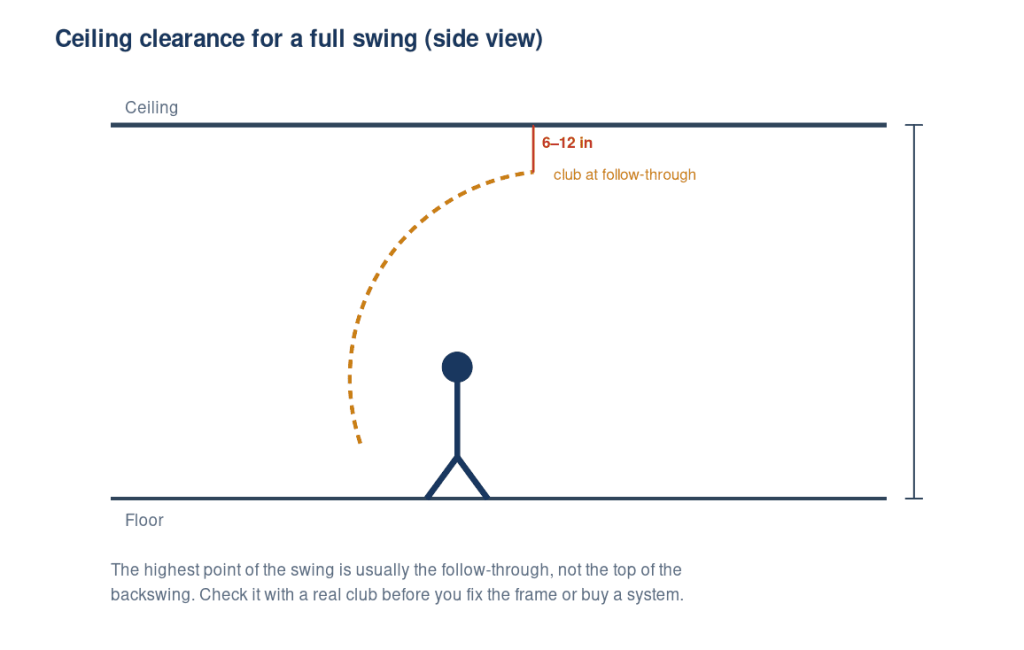
Two things catch people off guard. First, height matters more than most buying guides admit. A full driver swing needs roughly 9 feet of clearance, and a lower ceiling forces you to either mat-shift back or avoid full swings with longer clubs entirely. Second, depth requirements depend heavily on which type of launch monitor you buy, which is the bigger decision than the enclosure or screen.
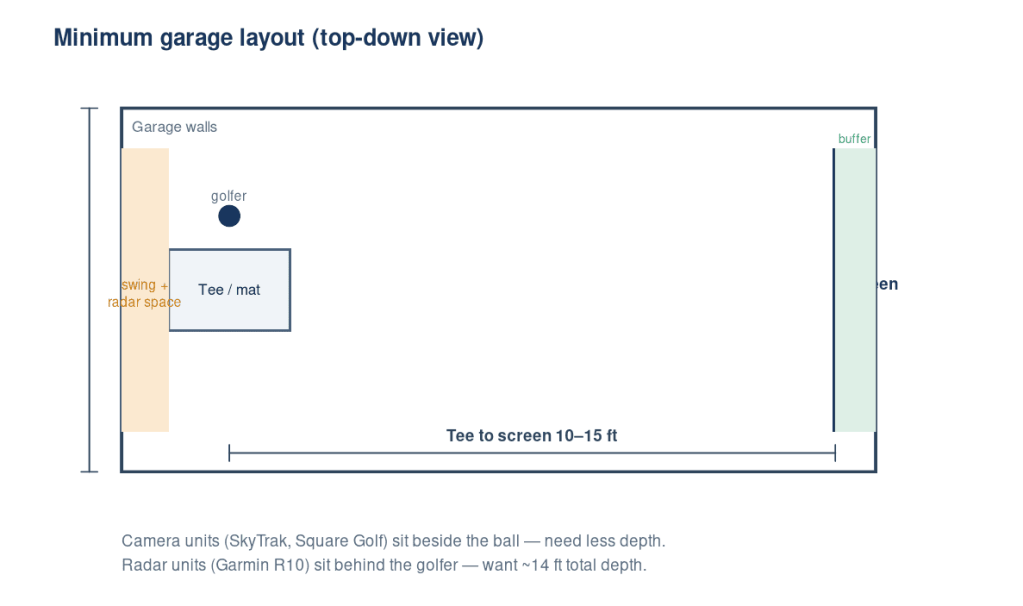
Before you commit to any of the systems below, test the actual space rather than trusting a tape measure alone. Take your longest club in, make a few slow practice swings, then a few at full speed, and pay attention to how the swing feels as well as whether it clears the ceiling. If you’re working with a genuinely tight single-car garage, check the door tracks too: the metal rails a sectional door runs on often cross right through the hitting area, and most garage door companies can reposition them higher for a few hundred pounds, which can be the difference between fitting a driver swing and not. And if the ceiling simply can’t accommodate a driver swing at all, a purpose-built golf simulator garden room is the alternative worth pricing.
Camera-based vs. radar-based: why it matters for small spaces
This is the specification that actually determines whether a simulator fits your garage, and it rarely gets explained clearly.
Camera-based / photometric systems (SkyTrak+, Uneekor EYE MINI, Bushnell Launch Pro) sit beside or slightly behind the ball and read the club and ball at impact. They need less room behind the hitting area, which makes them the better fit for tighter garages.
Radar-based systems typically sit behind the golfer and track the ball’s flight path over distance, which means they generally want more depth to get an accurate read. That makes them harder to squeeze into a single-car garage.
If your garage is on the smaller end, prioritize a camera-based launch monitor before you fall in love with a specific brand.
Best options by space
Tightest spaces (10×8.5 ft footprint): SkyTrak ST MAX Studio 10
SkyTrak’s Studio 10 package is built around three defined small-space configurations, the tightest being 10 feet wide, 8.5 feet high, and 5.4 feet deep. It’s designed specifically for the golfer who has a corner, not a room. Worth a naming note here: SkyTrak’s flagship launch monitor has recently moved from the SkyTrak+ to the newer ST MAX, so you may see this same small-space package sold around either unit depending on stock, confirm which one a specific listing includes. Both use dual Doppler radar for club data, don’t require marked balls or club stickers, and carry a UK RRP around £2,995, with SkyTrak+ regularly discounted while remaining stock clears.
Good for: golfers whose available space genuinely can’t accommodate a full swing setup, and who are willing to trade some swing freedom for having a simulator at all.
Ultra-tight depth (10 ft minimum): Uneekor EYE MINI LITE
If depth is your constraint more than width, the EYE MINI LITE is worth a look. It’s a dual-camera system delivering 19 tracked data points and needs a minimum of 10 feet of room depth. No marked balls required, and it’s portable if you ever need to move it. UK retailers including GolfBays and Golf Swing Systems stock it, but pricing isn’t consistently listed publicly, so get a current quote directly before budgeting around it. See our full SkyTrak+ vs Uneekor vs Rapsodo comparison for how it stacks up on accuracy and price.
Good for: golfers who want more swing data than a budget system provides, in a footprint that a standard SkyTrak setup can’t quite match.
Standard single or double garage (9-10 ft ceilings, 16-20 ft depth): Foresight GC3 + enclosure
For a more typical garage (9 to 10 foot ceilings, 16 to 20 feet of depth, room for one or two golfers) a Foresight GC3 paired with an enclosure (a SIG10-style setup is a common pairing) and a short-throw projector is a frequently recommended combination. UK pricing for the GC3 unit alone runs roughly £6,500 to £7,500 through retailers like Tekden, before you add the enclosure and projector. Camera-based launch monitors like the GC3 are popular for garage builds specifically because they don’t need meaningful room behind the hitting area and perform reliably under controlled indoor lighting.
Good for: golfers with a standard one or two-car garage who want a setup that feels closer to a dedicated golf simulator studio, and have the budget to match.
Budget-conscious, all-in-one: OptiShot 2
If your budget is the tighter constraint rather than your garage, OptiShot 2 is the more affordable route into simulator golf. The base unit runs roughly £375 to £540 from UK retailers such as Golf Swing Systems and GolfBays; a complete package with a short-throw projector and impact screen will cost more, so confirm current bundle pricing with the retailer before you buy. It tracks club path rather than full ball flight, with published accuracy within about 2 mph of club head speed, 1.5 degrees of face angle, and 1.9 degrees of swing path. That’s noticeably less precise than SkyTrak+ or Foresight’s camera systems, and it feels more like a golf video game than a training tool. Fair tradeoff for some golfers, not for others.
Good for: golfers who want the simulator experience and casual play more than tournament-grade practice data, at the lowest entry price.
Quick comparison
| System | Approx. UK price | Min. depth needed | Min. ceiling height | Best for |
|---|---|---|---|---|
| SkyTrak ST MAX (Studio 10) | £1,495-£2,995 | 5.4 ft | 8.5 ft | Tightest corners |
| Uneekor EYE MINI LITE | Get a current quote from a UK retailer | 10 ft | Not specified by manufacturer (confirm before buying) | Depth-constrained rooms |
| Foresight GC3 + enclosure | From around £6,500 (unit only) | 16-20 ft | 9-10 ft | Standard single/double garage |
| OptiShot 2 (base unit) | £375-£540 | Varies by package | Standard garage | Budget-first buyers |
Prices and specs reflect UK retailer listings and manufacturer data as of July 2026. Confirm current pricing and exact dimensions before purchasing, as these change without much notice.
Frequently asked questions
Can a golf simulator fit in a single-car garage? Yes, if you have at least 10 feet of usable depth and roughly 8.5-9 feet of ceiling height. Systems like the SkyTrak ST MAX Studio 10 package are specifically designed for footprints this size.
What’s the minimum ceiling height for a golf simulator? Around 9 feet is the general recommendation for a full, unrestricted swing with a driver. Some small-space packages work with ceilings as low as 8.5 feet, but you may need to be more careful with swing path on longer clubs.
Do I need a radar launch monitor or a camera-based one for a small garage? Camera-based (photometric) systems generally work better in tight spaces because they need less room behind the hitting area than radar-based systems that track the ball over a longer flight path.
Is OptiShot accurate enough to actually improve my game? OptiShot 2’s published accuracy (roughly 2 mph on club speed, under 2 degrees on face angle and swing path) is usable for casual practice and play, but it’s less precise than premium camera-based systems like SkyTrak+ or Foresight’s GC3. If serious swing analysis is the priority, budget for one of those instead.