
A golf practice net, also sold as a driving net or a garden golf net, costs £40 to £120 for a basic pop-up or cage net, £150 to £350 for a durable auto-return net that handles daily full swings, and £400 to £900 for a heavy-duty enclosure-style net that absorbs a driver almost silently. The price gap is not cosmetic: a cheap net built for chipping tears or rebounds the ball under full-swing speed, while the right one takes every drive you hit for years. Which net you need comes down to how hard, and how often, you will actually hit into it.

Here’s how the types differ, what’s worth buying in the UK, and the sizing and safety details that matter far more than the logo on the frame. We haven’t destruction-tested every net ourselves; the guidance below draws on manufacturer specs, independent testing and UK owner reports, and we flag where a verdict is research rather than hands-on.
Why a proper net matters more than you think
Every full shot fires the ball’s entire energy into the netting. A good net absorbs that and drops the ball; a bad one either tears at your favourite aim point within weeks or, worse, rebounds the ball back toward you at speed. The second failure is a genuine safety issue, not a preference, which is why net choice deserves more thought than most people give a “bit of netting”. If you only ever chip into it, a cheap net is fine. If you plan to hit driver, the net is the one component you should not buy on price alone.
The three types of golf net
| Type | Typical UK price | How it behaves | Best for |
|---|---|---|---|
| Pop-up / cage net | £40–£120 | Quick to pitch, lighter netting, some bounce-back | Chipping, occasional swings, tight budgets |
| Auto-return net | £150–£350 | Angled base returns the ball to your feet, fuller frame | Regular full-swing practice, most gardens |
| Heavy-duty / enclosure-style | £400–£900 | Near-silent, no rebound, tour-durable, sim-ready | Daily use, driver, building toward a simulator |
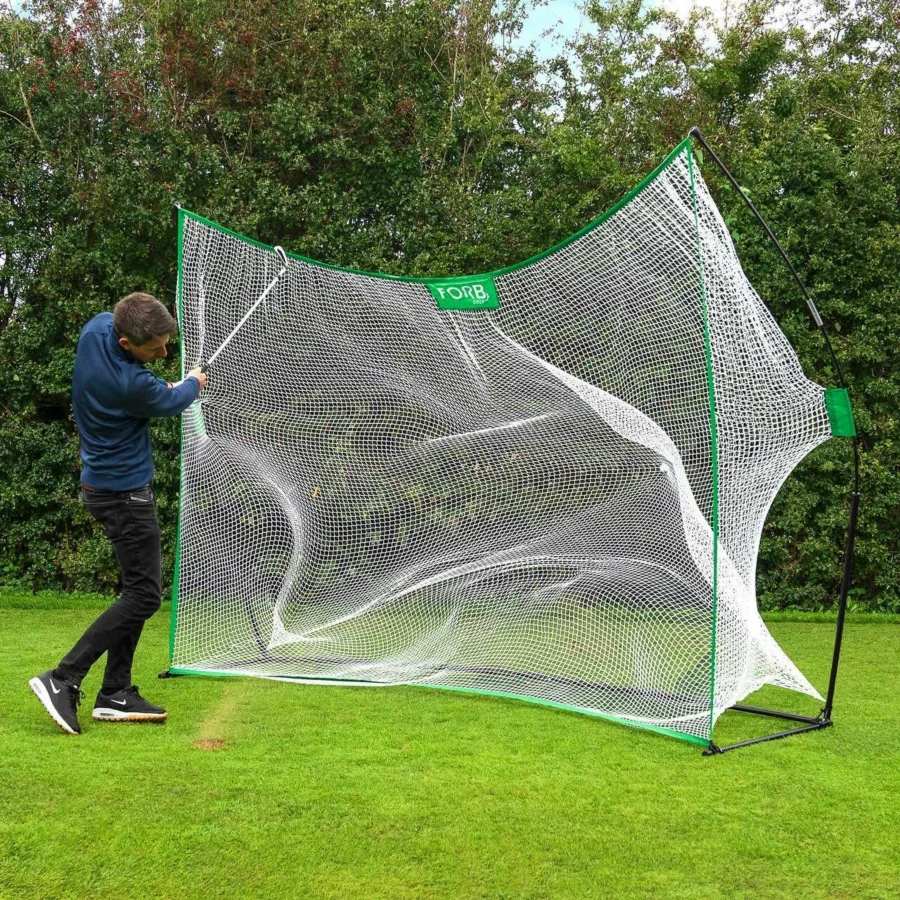
Pop-up and cage nets (£40 to £120). Widely sold on Amazon UK and by Net World Sports (FORB), GALILEO and similar. They pitch in minutes and pack away, which suits a garden you tidy between sessions. The trade-offs are lighter netting that wears faster, more rebound on flush strikes, and frames that catch the wind. If you want a budget net that will genuinely take full swings rather than just chips, an oversized catch-all like the IZZO ‘Beast’ Titan (12ft x 10ft, rated to 150 mph ball speed) is a real step up from a flimsy pop-up, though it has no ball return and some owners report the netting wearing under heavy use. A basic pop-up is still fine as a chipping target or the occasional full swing; it is not what you want for daily driver work.
Budget cage and driving nets from a UK specialist (Major Golf Direct): Longridge Cage · IZZO Titan · IZZO Titan Beast · Catch All 12ft.
Auto-return nets (£150 to £350). The sensible middle for most home practice, and where the Spornia SPG-7 has become the default recommendation. An inclined base channels the ball back toward you after each shot, the netting is multi-layered, and the sloped design cuts rebound. Rukket and PowerNet offer similar cage-and-return designs. This tier survives regular full swings and is the point at which a net stops being a compromise.
Where to buy on Amazon UK: The FORB 7ft portable hitting net and the TS Golf practice net bundle are both popular full-swing options.
Heavy-duty and enclosure-style nets (£400 to £900). Designs like The Net Return, built from dense baffle material, absorb impact almost silently, return the ball straight back, and are rated for hundreds of thousands of shots. They’re also the natural base to build a full simulator around later, since the frame accepts a side enclosure and screen. Worth it for daily use, driver-heavy practice, or shared walls where noise matters; overkill for a weekly chip-and-putt.

Sizing and safety: the part people skip
Buy for full-swing clearance, not the product photo. The net needs to be tall and wide enough that a slightly thinned or heeled shot still hits netting, not your fence or shed. For driver, that means a genuine full-swing net rather than a compact chipping box.
Stand the recommended distance back. Most nets want you around 8 to 10 feet away so the netting has room to absorb energy. Too close and even a good net can slap the ball back. Follow the maker’s distance, and never crowd a net to fit a smaller space.
Protect the sides and top, not just straight ahead. Mishits go sideways and skyward far more than beginners expect. Cage and enclosure designs with side barriers and a roof baffle exist for exactly this, and they’re the difference between a safe garden setup and a broken window. This is the same principle as the side and ceiling protection covered in our DIY enclosure guide.
Watch for rebound. A drum-tight flat net acts like a trampoline. The best designs hang with deliberate slack or use an angled baffle so the ball drops rather than returns. If a net has no give when you press it, expect bounce-back.
Golf nets in the garden: weather, wind and neighbours
Gardens add three considerations a spec sheet won’t. Weather: UV and rain degrade netting over time, so either choose a weather-resistant net you can leave up or a pop-up you take down between sessions. Wind: lightweight frames and pop-ups catch gusts and move; anchor them with pegs or weights on anything but a still day. Neighbours and noise: flush driver strikes into a cheap net are loud, and gardens are shared spaces. The heavier baffle nets are dramatically quieter, which is a real factor in a terraced or semi-detached garden.
Using a net with a launch monitor or building toward a simulator
A net plus a good hitting mat is the cheapest genuine practice setup, and it pairs naturally with a launch monitor for numbers. If you add a radar unit like the Garmin R10, remember it still wants room behind the ball even with a net in front, so check the space maths in our launch monitor guide. When you’re ready to project an actual course, a net alone won’t do it: you step up to an impact screen and an enclosure, and pair it with a proper hitting mat. The full cost breakdown shows where a net sits on the path to a full build.
Golf chipping nets: a different tool
A golf chipping net is a separate product from a full-swing driving net, and confusing the two is the single most common net-buying mistake. Chipping nets are small, light targets built for wedge and short-game shots, often with scoring pockets, and they are cheap, pack away in seconds and are genuinely useful for the short game. A multi-target net like the IZZO Triple Chip covers it for around £20. What they are not built for is a driver: hit a full swing into one and you will tear the net or send the ball straight back at yourself. If you want to practise both, buy a proper full-swing net for the long game and keep a chipping net as a separate short-game target, not a substitute.
Chipping nets from a UK specialist (Major Golf Direct): IZZO Triple Chip · IZZO Mini Mouth.
Common mistakes
Buying a chipping net for full swings. The most common source of both torn nets and broken fences. Match the net to the fastest club you’ll actually hit into it.
Standing too close. Crowding a net to fit the space removes its ability to absorb energy and invites rebound. If the space is too tight for the net’s stated distance, the space, not the distance, is the problem.
Ignoring side and top protection. Straight-ahead netting protects one direction. Mishits need somewhere safe to go too.
Leaving a cheap net out all winter. UV and damp shorten netting life fast. Weatherproof net or take it down.
Chasing the lowest price for driver practice. The net takes every swing you make at full speed. It’s the one place a bargain tends to cost more later, in replacements or repairs.
Frequently asked questions
How much does a golf net cost in the UK? £40 to £120 for a basic pop-up or cage net, £150 to £350 for a durable auto-return net suited to regular full swings, and £400 to £900 for a heavy-duty enclosure-style net like The Net Return. How hard and how often you’ll hit into it should set the tier.
Are cheap golf nets safe for driver practice? Some are, briefly, but many budget nets are designed for chipping and lighter swings and can bounce the ball back or wear through under repeated driver strikes. For regular full-swing and driver practice, a purpose-built full-swing net (auto-return or heavy-duty) is the safe choice.
What is the best golf net for a garden in the UK? For most gardens a mid-tier auto-return net like the Spornia SPG-7 (around £250 to £320) hits the balance of durability, safety and ball return. If noise or daily driver use matters, step up to a heavy-duty baffle net; if it’s occasional and budget is tight, a pop-up net is fine as long as you anchor it and take it down in bad weather.
How far should I stand from a golf net? Most nets recommend around 8 to 10 feet, which gives the netting room to absorb the ball’s energy rather than rebounding it. Always follow the manufacturer’s stated distance, and if your space is tighter than that, choose a net rated for close-range use rather than crowding a standard one.
Can I use a golf net for a home simulator? A net is great for practice and pairs well with a launch monitor for data, but it won’t project a course. For simulator play you need an impact screen and enclosure instead, though a heavy-duty net frame can often be the base you build that around later.
Do golf nets bounce the ball back? Cheap, tightly strung flat nets can. Well-designed nets use slack netting or an angled baffle so the ball drops or returns gently to your feet rather than flying back. If a net has no give when pressed by hand, expect some rebound.
About the author
By James, a keen amateur golfer and home golf simulator enthusiast. Everything on HomeSimGolf is assessed against manufacturer specifications, independent testing and UK owner reports, and we say plainly when a verdict isn’t hands-on.
Affiliate disclosure: HomeSimGolf is reader-supported. If you buy through links on this page we may earn a commission at no extra cost to you. As an Amazon Associate we earn from qualifying purchases.